Guide
Full-system hood clean vs canopy-only wipe
The fire load lives in the path grease travels — filters, plenum, ducts, and the rooftop fan — not just the stainless you see from the cook line. A low quote that only shines the canopy leaves the risk in place.
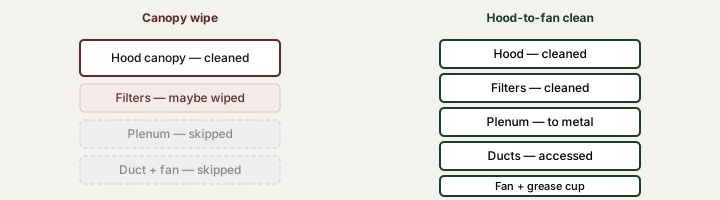

Scope comparison
| Section | Full-system | Canopy-only wipe |
|---|---|---|
| Hood canopy | Cleaned | Cleaned |
| Filters | Removed / cleaned or replaced | Often wiped in place |
| Plenum | Opened and cleaned to metal | Usually skipped |
| Horizontal duct | Accessed via panels | Skipped |
| Vertical duct | Accessed where panels exist | Skipped |
| Rooftop fan | Hinged / cleaned; grease cup checked | Skipped |
| Photos | Each section | Canopy vanity shot |
What good looks like
- Written list of sections included
- Inaccessible sections listed with reasons
- Fan hinged and cleaned when design allows
- Photo set matches the path diagram
What a cheap wipe looks like
- “Hood cleaning” with no duct line item
- Crew finished in far less time than roof access allows
- No mention of fan or containment
- Price far below other bids with no scope explanation
Field detail
- Access panels — missing panels = incomplete clean forever until installed
- Rooftop fan — upblast fans should hinge for service; fixed fans are a red flag for thorough cleaning
- Sticker — does not prove duct work
- Photos — demand plenum + duct + fan, not only filters
Access that separates a full clean from a wipe
Secondary sources republishing NFPA 96 (2024 ed.) excerpts make the scope difference mechanical, not marketing: if the crew cannot reach a section, they cannot claim it was cleaned. Confirm section numbers against the edition your AHJ adopts.
| Requirement (secondary NFPA 96 excerpt) | Why a canopy-only bid fails it |
|---|---|
| §4.1.8 — all interior surfaces of the exhaust system shall be accessible for cleaning and inspection | A wipe that never opens the plenum or duct leaves interior surfaces untouched |
| §7.3.1 / §7.4.1.2 — openings at changes of direction; where a 20×20 in. entry is not possible, openings large enough for thorough cleaning at 12 ft (3.7 m) intervals on horizontal duct | No panel line-item usually means long horizontal runs stay greasy between elbows |
| §7.8.2.1(8) / §8.1.2.1 — hinged upblast fan with flexible weatherproof cable and service hold-open retainer for inspection/cleaning | Fixed fans or “roof not included” quotes skip the fan housing where grease collects |
| §8.1.2.3 — upblast fan drain to a readily accessible/visible grease receptacle not exceeding 1 gal (3.8 L) | Canopy crews rarely check or empty rooftop containment |
| §12.6.1 — contaminated portions cleaned by properly trained, qualified, and certified person(s) acceptable to the AHJ (annex note cites ANSI/IKECA C10 as cleaning methodology guidance) | “Hood cleaning” without duct/fan scope is not a full-system clean under that methodology framing |
Operator move: put duct access, fan hinge, and grease-cup checks on the same bid sheet as the canopy. If the vendor marks sections inaccessible, get that in writing and schedule panel work — do not accept a shiny canopy as proof the path is clean. See duct access panels, rooftop fan access, and grease cup / rooftop containment.
Who it’s for / not for
- For: anyone comparing bids or recovering from a failed inspection
- Not for: assuming the cheapest line-item is equivalent scope
Sources
- IKECA FAQs — access panels, fan hinges, cleanliness
- TFP — hood cleaning cost context (secondary; ranges not reproduced as bids here)
- HoodFilters — NFPA 96 excerpts (2024) (secondary; §§4.1.8 accessibility; 7.3.1 / 7.4.1.x duct openings & 12 ft spacing; 7.8.2.1 / 8.1.2.1 fan hinge; 8.1.2.3 ≤1 gal receptacle; 12.6.1 cleaning personnel; A.12.6.1 ANSI/IKECA C10 note)
- IKECA — ANSI/IKECA standards (C10-2021 cleaning methodology; works in concert with NFPA 96)
- US Made Supply — NFPA 96 access / cleaning summary (secondary)
Next step
On your next bid request, paste the component list from the full-system page and require a yes/no on each line.